
Mobula alfredi (reef manta ray)
Manta rays in Nusa Penida and Nusa Lembongan
Reef manta rays are the animal most divers come to this corner of Bali to see, and they are around for all of them, gathering at cleaning stations and feeding grounds on Nusa Penida's south-west coast every month of the year.
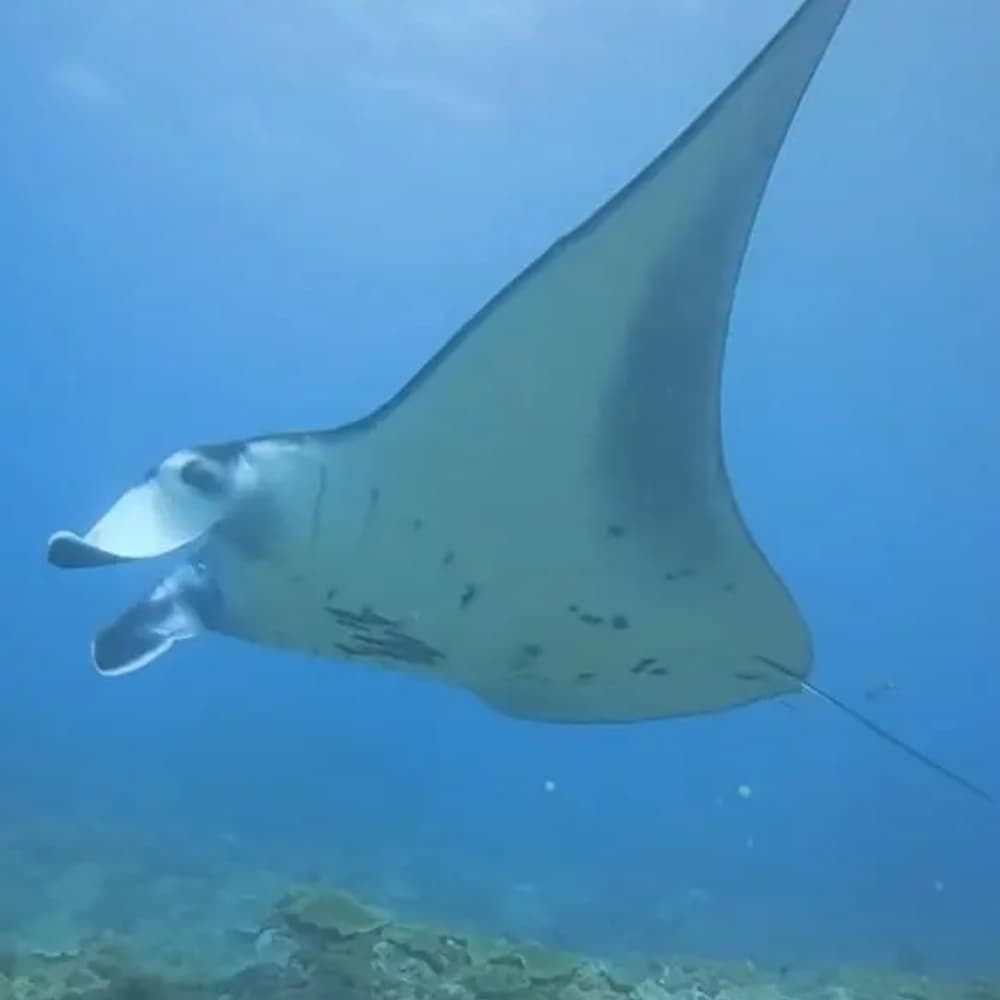
- Species
- Reef manta ray (Mobula alfredi), with occasional visits from the oceanic manta ray (Mobula birostris)
- Size
- Average disc width 3 to 3.5 m, with the largest recorded individuals over 4 m
- Weight
- Up to around 840 kg
- Diet
- Zooplankton, filtered from the water column as it swims
- Where to see them
- Manta Point and Manta Bay, Nusa Penida
- Season
- Year-round
- Depth usually seen
- 5 to 20 m
- Conservation status
- Vulnerable (IUCN Red List)
| J | F | M | A | M | J | J | A | S | O | N | D | |
|---|---|---|---|---|---|---|---|---|---|---|---|---|
| Manta rays | January: Best months | February: Best months | March: Best months | April: Best months | May: Best months | June: Best months | July: Best months | August: Best months | September: Best months | October: Best months | November: Best months | December: Best months |
| Mola mola | January: Rare | February: Rare | March: Rare | April: Rare | May: Rare | June: Possible | July: Good chance | August: Best months | September: Best months | October: Good chance | November: Possible | December: Rare |
Wildlife is never guaranteed. The mola season shifts a little each year with the cold water.
What is a reef manta ray
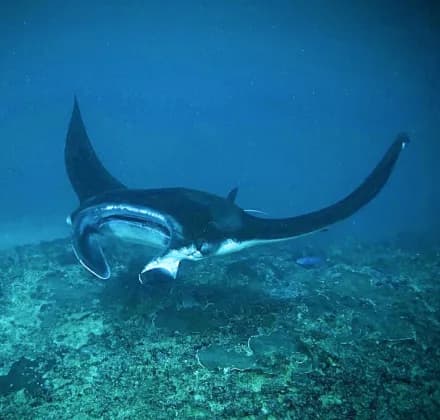
The reef manta ray, Mobula alfredi, is one of the two manta species divers can encounter, and by far the more common of the two around Nusa Penida. It has a broad, flattened body built around a pair of large pectoral fins that it beats slowly to glide through the water, and two forward-facing cephalic fins either side of its mouth that unfurl into a funnel shape while it feeds. An average reef manta measures 3 to 3.5 metres from wingtip to wingtip, and the largest individuals on record have exceeded 4 metres and weighed close to 840 kilograms.
The reef manta's cousin, the oceanic manta ray (Mobula birostris), grows considerably larger, but stays mostly in open water far from the coast and is only an occasional visitor to Nusa Penida's dive sites. Almost everything you see on a manta dive at Manta Point or Manta Bay is a reef manta, distinguishable from the oceanic species by its shorter tail and the patterning on its underside, which is unique to each individual in the same way a fingerprint is. Researchers and citizen scientists use photographs of that belly pattern to identify and track individual mantas over years, which is how much of what is known about their movements and site fidelity has been learned.
Reef mantas are filter feeders, living entirely on zooplankton that they sieve from the water using comb-like gill plates. Because zooplankton is not especially calorie-dense, a manta has to process a large volume of water to get enough to eat, which is part of why they spend so much time cruising slowly with their mouths open rather than resting.
Reef mantas are also slow to reproduce. Females typically give birth to a single pup after a gestation of around a year, and individuals do not reach sexual maturity for several years after that, with long gaps between pregnancies on top. That slow reproductive rate is a big part of why manta populations are so easily affected by fishing pressure and so slow to recover once numbers drop.
Cleaning stations and feeding
Nusa Penida's two manta sites show the species doing two different things. At Manta Point, mantas visit a cleaning station: a patch of reef where small cleaner fish pick parasites and dead skin from the manta's gills, skin and the underside of its wings. A manta will often circle back to the same cleaning station repeatedly over a dive, and sometimes over years, which is what makes the encounter reliable enough to plan a dive around.
At Manta Bay, mantas are usually feeding rather than being cleaned, sweeping through the shallows with their cephalic fins unfurled and mouths open to filter plankton concentrated near the surface. Feeding mantas move along a path rather than holding position, so diving here is more about finding a spot with a clear view of that path than waiting in one place.
Both behaviours are examples of site fidelity: mantas returning to the same, specific locations because those locations reliably offer either food or cleaning services. It is the reason Nusa Penida's manta sites work as well as they do, and also why disturbing the cleaning station or feeding path with careless diving can affect whether the mantas keep using it.
Reef mantas are also social to a degree unusual among rays, sometimes forming loose groups at a cleaning station or along a feeding line rather than always appearing alone. Individuals recognised from Manta Point's cleaning station have been seen returning to the same spot repeatedly, which is part of why a well-run operator can offer a genuinely high chance of a sighting rather than a hopeful guess.
Diving with manta rays responsibly
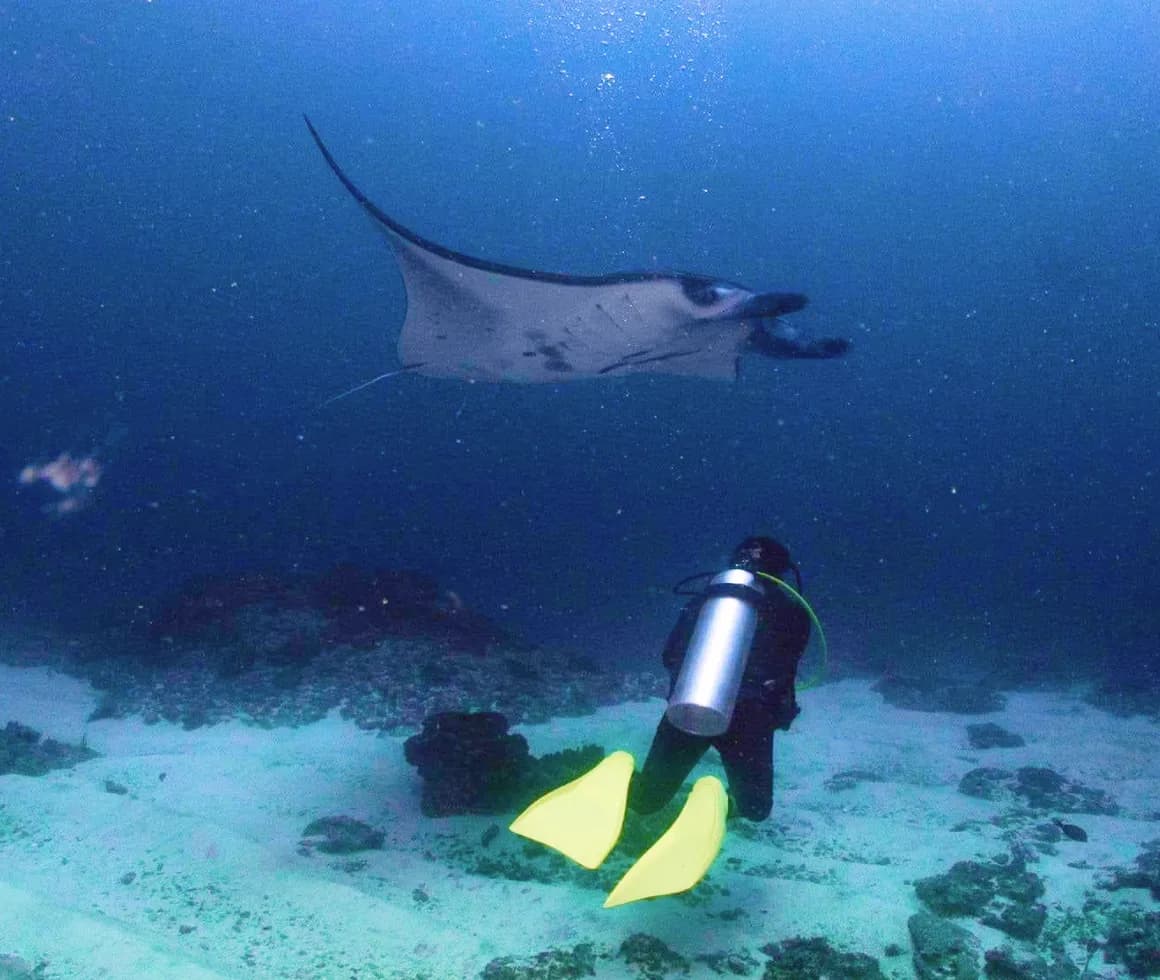
Manta rays are large, calm animals that show little fear of divers, which makes it easy to get too close without meaning to. The basic etiquette is straightforward: stay low over the reef or sand rather than swimming up toward the animal, keep a minimum distance of around 3 metres, and let the manta set the pace of the encounter rather than swimming to intercept it.
Never touch a manta ray. Their skin is covered in a thin mucus layer that protects them from infection, and human contact strips it away, leaving the animal more vulnerable to parasites and disease. The same goes for chasing: a manta that feels pursued will simply leave the area, which ends the encounter for everyone else in the water too.
Flash photography is best avoided close to a manta's eyes, and exhaust bubbles should be kept away from the underside of the animal where possible. At a cleaning station in particular, staying low and still rather than hovering mid-water gives the cleaner fish room to work and keeps the manta relaxed enough to stay.
Group behaviour matters as much as individual behaviour. A cleaning station with several boats and a dozen divers can push the mantas away entirely if everyone crowds in at once, so Sober Diving briefs divers to spread out along the edge of the station and take turns rather than clustering directly over the animal. Snorkellers sharing the water are held to the same rules as divers.
When and where to see them
Reef manta rays are present at both Manta Point and Manta Bay every month of the year, which is unusual for a headline dive animal in this part of Bali and very different from the strict July to October season for mola mola. Morning trips generally offer calmer seas, clearer water and fewer other boats at the cleaning station, since conditions at both sites tend to deteriorate through the day.
Sober Diving runs manta trips to whichever of the two sites suits the day's conditions and, where relevant, adds the standard fuel surcharge that applies to Manta Point trips. Both sites sit within easy reach of Nusa Lembongan, and either works as the highlight dive of a fun diving day.
Conservation
Reef manta rays are listed as Vulnerable on the IUCN Red List. Their biggest threats are targeted fisheries that catch mantas for their gill plates, used in some traditional medicine markets, and accidental bycatch in nets set for other species. Because mantas are slow to reach sexual maturity and produce very few young over a lifetime, populations recover slowly from any of these pressures.
Climate change is a growing, less direct threat, since shifts in ocean temperature and productivity affect the zooplankton mantas rely on for food. Sober Diving's conservation course covers reef manta biology and threats in more depth for anyone who wants to go beyond a single encounter, and every fun dive briefing includes the same stay-low, no-touch etiquette described above.
Responsible tourism plays a genuine role in protecting mantas at sites like these. A cleaning station that consistently brings in dive boats gives the local community and dive centres a direct, ongoing reason to protect the manta population rather than see it as a one-off catch, which is part of the broader argument for diving these sites properly rather than treating a sighting as disposable entertainment.
Questions
How big do manta rays get in Nusa Penida?
The reef manta rays seen here average 3 to 3.5 metres across, with the largest individuals on record exceeding 4 metres. They are smaller than the oceanic manta ray, which is only an occasional visitor to these sites.
Are manta rays dangerous to divers?
No. Manta rays have no sting or teeth capable of harming a diver and feed only on plankton. The only real risk is to the manta, from divers who get too close, touch it or block its path.
Can I touch a manta ray if it swims close to me?
No. Touching removes the protective mucus layer on a manta's skin and leaves it more vulnerable to infection. Stay still and let the animal choose the distance.
What is the best time of year to see manta rays in Nusa Penida?
Any time. Reef manta rays are present at Manta Point and Manta Bay year round, unlike mola mola, which has a strict July to October season. Morning dives generally offer the calmest conditions.
What is the difference between a reef manta and an oceanic manta?
The reef manta ray (Mobula alfredi) is the species you will almost certainly see around Nusa Penida, smaller than the oceanic manta ray (Mobula birostris) and far more likely to stay close to the reef at cleaning stations and feeding grounds.
See manta rays with us
Tell us your dates and certification level and we will plan your dives around the best chance of an encounter.