
Mola alexandrini (bump-head sunfish), commonly called mola mola
Mola mola in Nusa Penida
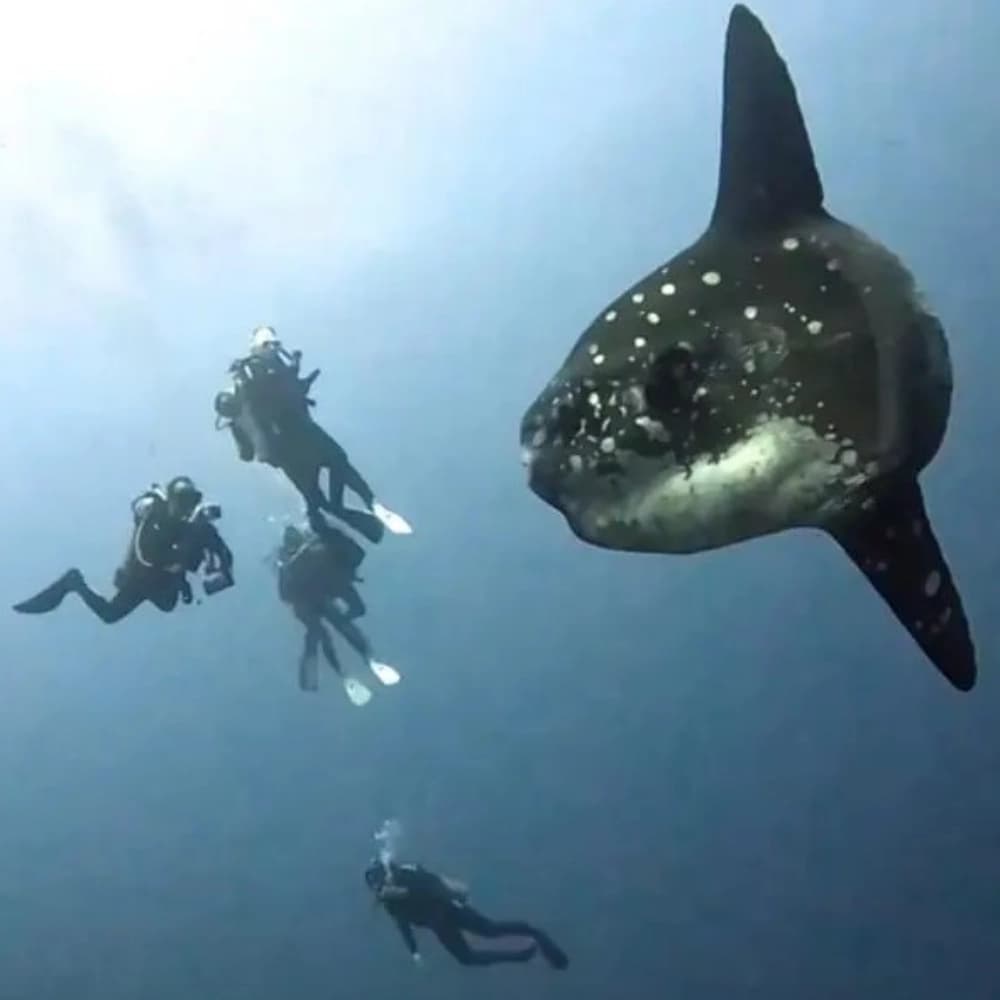
Nusa Penida is one of the most reliable places in the world to dive with a mola mola, the giant, flattened sunfish that rises from deep, cold water to shallower cleaning stations for a few months each year.
- Species
- Mola alexandrini (bump-head or southern sunfish), the species seen around Bali; almost everyone still calls it mola mola
- Size
- Up to around 3.3 m in length
- Weight
- Can exceed 2 tonnes; the record specimen weighed 2,744 kg
- Diet
- Mainly jellyfish, plus zooplankton, squid and small crustaceans
- Where to see them
- Crystal Bay, Blue Corner and Ceningan Wall
- Season
- Roughly July to October, peaking in August and September
- Depth usually seen
- 20 to 35 m at cleaning stations
- Conservation status
- Not yet separately assessed by the IUCN; targeted fishing for its flesh is a recognised regional threat
| J | F | M | A | M | J | J | A | S | O | N | D | |
|---|---|---|---|---|---|---|---|---|---|---|---|---|
| Manta rays | January: Best months | February: Best months | March: Best months | April: Best months | May: Best months | June: Best months | July: Best months | August: Best months | September: Best months | October: Best months | November: Best months | December: Best months |
| Mola mola | January: Rare | February: Rare | March: Rare | April: Rare | May: Rare | June: Possible | July: Good chance | August: Best months | September: Best months | October: Good chance | November: Possible | December: Rare |
Wildlife is never guaranteed. The mola season shifts a little each year with the cold water.
What is a mola mola
Mola mola is the name almost every diver and dive centre uses, but the fish most commonly encountered around Nusa Penida is now recognised as its own species, Mola alexandrini, also known as the bump-head or southern sunfish. It was only distinguished from the more widely known Mola mola through genetic research, and because the older name is so well established, it has stuck in everyday use, including on this page.
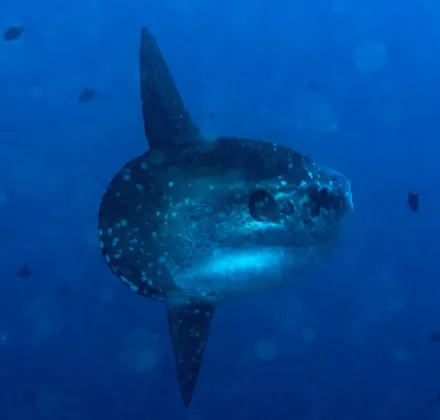
It is an unmistakable animal: a flattened, almost circular body with no real tail, ending instead in a rudder-like structure called a clavus, and long dorsal and anal fins that it sculls from side to side to move. Adults reach around 3.3 metres in length and can weigh more than 2 tonnes, making it the heaviest bony fish in the ocean. The largest confirmed specimen, caught off the Azores in 2021, weighed 2,744 kilograms, beating the previous record of 2,300 kilograms set off Japan in 1996.
Growth is remarkably fast for such a large animal. A mola mola measures only a few millimetres as a larva and around 60 centimetres as a juvenile, then puts on most of its adult size within just a few years. Females do not reach sexual maturity until roughly their mid-teens and, once mature, release enormous numbers of eggs in a single spawning event, a reproductive strategy built around very high early mortality rather than a small number of well-protected young.
Mola alexandrini spends most of its life in deep water, down to several hundred metres, which is why divers only get a realistic chance of seeing one during a specific seasonal window each year. It is also regularly seen basking on its side at the surface elsewhere in its range, a behaviour thought to help it re-warm after a deep, cold dive, top up its oxygen and let seabirds pick parasites from its skin.
Why they come up: the upwelling season
Between roughly July and October, a seasonal upwelling current brings cold water up from the depths of the Lombok Strait toward Nusa Penida. This is a genuine oceanographic event, not simply a period when divers get lucky: the cold water carries mola mola with it, up from their usual deep, cold habitat to depths that recreational divers can safely reach.
The fish come to shallower water for a second reason as well as the cold: cleaning. More than 40 species of parasite can live on and under a mola mola's thick skin, and the fish relies on smaller reef fish, particularly bannerfish, to pick them off at cleaning stations. A mola mola will often tilt to around 45 degrees while this happens, exposing more of its flank to the cleaner fish, and it is during this tilted, distracted posture that divers get their closest, calmest views.
A heavy parasite load is thought to be one reason mola mola make the trip up from deep water in the first place, since the cold, low-light conditions they normally live in offer far fewer cleaner fish than a shallow reef does. Scientists studying the species have also taken an interest in how it tolerates certain parasites and toxins, research that has wider potential applications beyond the fish itself.
Outside the July to October window, water temperatures rise and the upwelling stops, and mola mola return to depths well beyond recreational diving. Trying to plan a mola mola dive outside the season is close to pointless, whatever an operator promises.
Where to dive with mola mola
Crystal Bay is Nusa Penida's best-known mola mola site and the one most likely to have a cleaning station active on any given day in season, though it also carries the strongest currents and, at times, a genuine down-current hazard. Blue Corner and Ceningan Wall see mola mola in the same season, generally with fewer boats and divers competing for the same sighting, though with their own demanding currents.
A cold thermocline, often around 18 to 22 metres, usually marks the transition into the water mola mola prefer, with temperatures dropping into the high teens Celsius or lower. Guides watch for this thermocline and for schools of bannerfish holding position in open water as the clearest signs that a mola mola is nearby.
Sightings are seasonal, never guaranteed on a single dive, and depend heavily on a guide who reads the current and the signs correctly. A full day with multiple dives across the season genuinely improves your odds compared with a single dive, and diving in the days around a new or full moon is, anecdotally, associated with more frequent sightings by some local guides, though this has not been formally studied.
How to behave around a mola mola
Mola mola are easily startled, and a fish that feels pursued will simply sink back into deep water, ending the encounter for the whole group. The approach that works is the opposite of instinct: stay behind and above your guide, hold still, and let the animal set the pace rather than swimming toward it.
The best moment to close the distance slightly is when the mola mola tilts to around 45 degrees and bannerfish begin cleaning it, since it is genuinely more tolerant of divers while this is happening. Even then, approach low and slowly, never block its route back to open water, and never attempt to touch it. As with manta rays, flash photography close to the animal is best avoided.
Group size and noise matter more with mola mola than with most reef animals. A crowd of divers all finning hard toward the same sighting, or a diver breathing loudly and erratically from excitement, is often enough to send the fish back into the depths before anyone gets a proper look. Staying calm, breathing normally and letting your guide manage the group's positioning gives everyone the best chance of a longer encounter.
Conservation
Mola alexandrini has not yet been separately assessed on the IUCN Red List, since it was only formally distinguished from Mola mola in recent years, but sunfish as a family face real pressure from targeted fisheries in some countries, where the flesh is considered a delicacy, and from accidental capture in nets set for other species. A female mola mola can release an enormous number of eggs in a single spawning, but very few survive to adulthood, which makes the species more vulnerable to fishing pressure than that number alone suggests.
Because mola mola are only reliably found in shallow water during a short seasonal window, Nusa Penida's cleaning stations see intense, concentrated diver traffic for a few months each year. That concentration cuts both ways: it gives local dive centres and communities a strong economic reason to protect the sites and the animals, but it also means crowding, noise and careless diving are more likely to affect a mola mola here than almost anywhere else it is found.
Sober Diving's conservation course covers mola mola biology and threats alongside manta ray conservation, and every mola mola dive is briefed with the same distance and no-touch rules described above, both to protect the animal and to give the whole group a longer, calmer sighting.
Questions
Is mola mola the correct name for the sunfish seen in Nusa Penida?
Not scientifically. Genetic research has shown the sunfish commonly seen here is Mola alexandrini, a distinct species from the true Mola mola, though the name mola mola remains what almost every diver and dive centre uses.
When is mola mola season in Nusa Penida?
Roughly July to October, peaking in August and September, when a cold-water upwelling brings the fish up from deep water to shallower cleaning stations.
Will I definitely see a mola mola if I dive during the season?
No sighting is guaranteed on any single dive. Diving multiple times, ideally across a full day and at more than one site, meaningfully improves your chances.
Can I touch a mola mola if I get close to one?
No. Touching a mola mola, like any marine animal, can damage its protective skin and will almost always end the encounter by startling it back into deep water.
How deep do you need to dive to see a mola mola?
Cleaning stations at Crystal Bay, Blue Corner and Ceningan Wall are usually found between about 20 and 35 metres, which is why Sober Diving asks for Advanced Open Water certification and current experience before booking these sites.
See mola mola with us
Tell us your dates and certification level and we will plan your dives around the best chance of an encounter.